Keeping Track of a Lost Nut

YouTube should be banned. I spent five minutes watching a man perform a small engine repair, which inspired me to waste three hours trying to attempt the repair myself before I finally realized I had better just load up the trailer and fork over cash to someone more competent in Briggs and Stratton mechanics. This was yet another blow to my pride. I’ve already surrendered basic auto repair over to others and now I can’t even fix my own lawn mower. 

I’d like to think I could have fixed it myself if I had the proper tools and time, but who am I kidding? If I had the proper tools, I would have spent half a day searching for them because apparently all my tools go on vacation just when I need them most. For instance, I spent nearly thirty minutes on my hands and knees searching through the grass for a ⅝ hex nut that I thought I had dropped. Really, it was just living the high life and sunning on top of a wooden fence post. I had put it on the fence post so I wouldn’t lose it, but that only works if you remember that you put it there. 

The problem is I’m one of those people who doesn’t have a brain for details. Never have, never will. In college, one of my dorm mates could watch any run-of-the-mill movie once and then recite large portions of dialogue, word for word, back to you a year later. Meanwhile, if I watched the same movie, I would have forgotten nearly everything about it within hours, no alcohol needed to perform that feat. I mean, I’d remember the gist of the movie, like who lives or dies or falls in love, etc, but details like dialogue and characters’ names would be lost to me. 

And thus it is with my repair efforts. I often know the gist of how to repair something, but distilling the gist down to nuts-and-bolts details is where I go awry, hence the unneeded search and rescue mission for the lost nut chilling on the fence post. 

Thankfully, opposites attract, and I married a woman who lives and breathes details and plans and schedules. She more or less keeps track of the lost nut that is me and tells me the important details of day-to-day life that I need to know. In return, I cut the grass each week (at least when the lawnmower isn’t broken), take out the trash, and occasionally load the dishwasher. 

Sometimes I think her color-coded daily planner is her first love, but I can’t complain too much. If she didn’t love me a little bit, I figure she would have poisoned me years ago, likely by sneaking a daily planner into my hands to cause anaphylactic shock. 

Some Serious Beekeeping Advice

There’s a certain cruelty to beekeeping: By the time you finally figure out what you’re doing, you’ll likely lack the drive to do it. And by drive, I mean the DMV will have revoked your license because you’ll be old and decrepit and generally untrustworthy to operate a motor vehicle. The learning curve for beekeeping is that long and arduous. 

This is my tenth year keeping bees, at least if you count the first five years which were mostly me killing bees. So in commemoration of ten years of beekeeping, I thought for once I’d actually try to give some practical advice on this blog, so here it goes: 

For bees, the next three months are incredibly important. Hives aren’t lost during winter. They’re lost during July, August, and September. Usually what happens is beekeepers (myself included) get really excited about bees in the spring. As spring progresses toward summer, some of that excitement fades because, let’s face it, working hives is hard work. Harvesting honey during the middle of July is even harder work. Once your honey is in jars or buckets or barrels, you feel like you’ve accomplished your goal and take a well-deserved rest. Wrong. At least here in NC, July, August, and September are the most crucial months in beekeeping. Often there is a severe summer dearth of nectar and pollen. Couple this with exploding varroa levels, and you’ve got a recipe for a dwindling hive. So by the time October rolls around, you may only have a few frames of bees, which is not what you want going into winter. Though that hive will likely die during a February arctic freeze, it was really lost in late summer.  

So my advice is this: steel yourself for the upcoming dog days of summer and invest in a bee jacket with good wicking technology. It’s a lot cheaper than buying new bees each year.

Happy July 4th!

How to Solve the Farm Problem

By George! I’ve done it. I’ve solved “The Farm Problem.” Well, really my wife solved it after I asked her if she had seen a hammer recently.

“Which hammer?” she asked. 

“Any hammer,” I said, “The red one or the blue one or the neon green one.” The latter was supposed to glow in the dark in case I ever lost it at night. However, I lost it during the day. 

“No, the last time I saw a hammer it was lying somewhere,” she advised.

I went to check all the usual places a pounding implement might lay, hang, or drop on my farm, but after an extensive search, I chalked up another casualty to the Bermuda Triangle for hammers, tape measures, and quarter-inch wrenches that centers over our farm. 

The Farm Problem, you’ll remember, is the fact that farmers can’t afford to farm. This problem has persisted for eons; in fact, some economists speculate it dates back to when the first nomads gave up hunting and gathering and decided to feed the world. And yet, my wife quickly solved it when I returned home with a new orange hammer from the hardware megastore. (Interestingly, I can’t remember the location of a single hammer on my own farm, but I’ve memorized the aisle and bin number for all tools at the hardware store). Upon my arrival home with a new hammer, she said, “We’d have a lot more money if you’d stop buying the same tools over and over again.”

“Oh contraire,” I replied. “You’re forgetting opportunity costs. By buying a new hammer, I save time searching for an old one–and time is money.”

“Don’t flatter yourself,” she said, “I believe there’s an inverse relationship between the time you spend trying to farm and the direction of our bank account.”

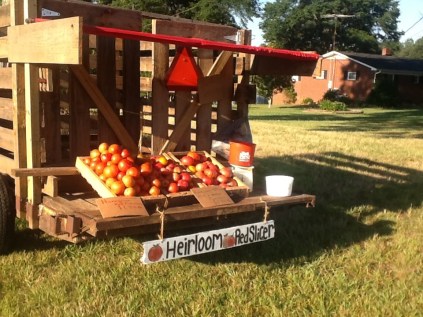
“Hmpph,” I said, “Just think about all that money we made selling homegrown tomatoes on the roadside stand. We even had a few Sacagawea coins in the honor box. Those’ll be worth millions one day.”

“What about that old rusty hammer-mill thing you bought,” she asked, “can’t you just make hammers in it?”

“No, absolutely not. A hammer mill does not make hammers. It grinds grain to smithereens so animals can get the full nutritional value of my homegrown oats, barley, and corn blend.”

“They should call it a grain mill then, not a hammer mill,” she said, “Furthermore, you should just put your tools in their proper place–that would solve the whole farm problem.”

And there you have it. Farm problem solved.

Our tomato stand.

Farmer Strong

I used to have a ball cap from my local farm credit. It simply said “Carolina Farm Credit,” and I wore it so frequently that after a few years my wife retired it in a trash can without my consent. So I asked our local farm credit representative if I could have a new hat, and he obliged–only, the new hat says, “Farmer Strong.” 

Ugh.

Might as well give a squirrel a hat that says “Grizzly Bear Strong.” Then the squirrel could stroll around the forest understory feeling self-conscious and a little ridiculous, all because of his headwear. I mean, don’t get me wrong, I’m used to feeling like a moron because of my actions, but feeling like an oxymoron because of my wardrobe is a step too far. Sadly, my physique does not exude superior strength, no matter what my hat proclaims. 

Case in point,  I was once blown away by a stiff breeze. Of course, had I known the power of hay tarps, I wouldn’t have tied a tarp corner to a belt loop (to keep my hands free while traversing the haystack) and, in so doing, affixed myself to a sixty-foot by forty-foot sheet of polyethylene. When the wind gusted, the tarp plucked me off the side of the haystack, and I instantly realized why parasailing occurred over water. It’s amazing the epiphanies you have while skittering across the stubble of a freshly-cut hay field. 

Then there was the time I lost a wrestling match with a pig. It was your basic muddy pig-pen match. My wife wanted to perform life-saving healthcare on the pig’s ear, so I jumped on the pig’s back and tried to pin it down. The squealing pig, however, performed a technically-demanding wrestling maneuver, what’s called a  reverse cradle, and quickly pinned me. In so doing, the pig busted my glasses (free farming advice: never wear glasses while wrestling a pig) and then trotted around the fence-line, grunting and gloating. 

And it’s not just me. Have you been to the sale barn lately? You’re not likely to see many strapping specimens of the human species. The sale barn is where farmers go to trade cows and cardiologists go to find new patients. Once upon a time the act of digging post holes, carrying feed sacks, and hefting hay bales caused farmers muscle fibers to expand. Now post-hole augers, front-end-loaders, and hay spears mean farming is less physically demanding than ever; it’s become more or less sitting in a tractor seat and moving a joystick. 

But I’ll tell you who is strong. It’s the unseen men and women in the blackberry rows, the one’s picking tractor-trailer loads of berries, berry by berry, until their fingers are stained with blood or berries or both (those are no thornless canes, I assure you). It’s the five-person Guatemalan “catching crew” whose job is to bend down and pick up every eight-pound chicken, in a poultry house full of twenty thousand chickens, and stuff them in cages for transport so we can later devour those Chick-fil-A sandwiches. It’s the workers in the pumpkin fields who heft every single jack o’ lantern, all so we can carve a silly face in it. 

All kidding aside, a “Farmer Strong” hat would look a lot better on them than me. 

Bon Appetit, Your Pipe Repair is Served

I know most people are tired of masks, but they do come in handy in times of crisis, like when you smell like a sewer and need to purchase miscellaneous items for an emergency pipe repair. Under normal circumstances, after digging up the oozing drain pipe, I would have at least taken a few seconds to spritz myself in Febreze before departing for Lowes. In Covid times, when people’s nostrils are covered, I figure I can save a few seconds and go straight to Lowes smelling like a swamp rat and not bring shame and disgrace on my household. 

My wife is not a big fan of malodorousness. In fact, one of her major weaknesses is sensitivity to smells, mainly those that adhere to and emanate from my person. Sometimes she says I smell like the barn, calves, pigs, or moldy hay. The fact that she can distinguish each of the aromas is proof that her petite nose is fertile ground for olfactory receptors. Meanwhile, the large acreage inside my nostrils is mostly barren wasteland, incapable of growing much but mucus. Of course, if an overactive nose was her worst feature, then I’d be just fine. Wearing deodorant mostly everyday is a small sacrifice to make, and everybody has flaws. But the fact that she also has a weak stomach compounds the problem.

“That smell makes me feel queasy,” she says one day.

“That stench is nauseating,” she claims, as I walk through the door.

“You smell like a trash can. I’m going to throw up,” she warns.

“What smell?” I  ask.

To help me understand the subtleties of my aromas, she often resorts to food analogies. Stale means I’m past my expiration date for a shower. Sour means the sweat on my body is fermenting and rising. Burnt means I smell like the charred inside of my bee smoker and need to be hosed down before the fire spreads. Fishy means I protrude the smell of freshly-caught bass, hopefully of the wall-hanging variety. 

Anyway, I made it in and out of Lowes without leaving a trail of dry-heaving and gagging people in my wake, successfully completed the repair, and then (after all that work, in the misting rain no less) was barred from entering my house by my very own wife. She stood guard at the back door and made me strip off my clothes and put them in a trash bag. I was only allowed entry on the condition that I would go straight to the shower and scrub real good. 

“You smell like rotten eggs,” she said. 

an oozing burst drain pipe