My Religious Thoughts on Rocks

“It’s all downhill from here.” That saying pretty much sums up the walk from the living room to the kitchen–sure, there is some rolling terrain in the dining room, where the floorboards gently rise and fall over a few uneven joists, but generally you’re losing a few inches in elevation whenever you visit the refrigerator. Little topographical quirks really distinguish old farmhouses from modern builds that are mostly bland, banal, and level. 

Years ago, when we first bought the old farmhouse from my wife’s grandpa, I undertook the process of trying to jack up the house at various spots. I spent many hours crawling around underneath the house, pondering deep philosophical questions, like whether the desire for level floors was a vain desire? After several muscle groups sent a distress signal to my nervous system, I decided that the desire for level floors was the vanity of all vanities. Mostly, I just laid underneath the house and annoyed all the spiders living in the crawlspace. I’m not sure if spiders have ears, but I hope none of them pull a Charlotte’s Web and write what I was muttering.

Our house sits on short fieldstone piers. Why my wife’s ancestors built the house so close to the ground is beyond me. It’s not like there was a shortage of fieldstones. We have all makes and models of fieldstone: big ones, little ones, and some exotic foreign makes that were imported underneath glaciers. I know about the origin and morphology of rocks because in third grade I collected rocks. Unfortunately, I never found any good rocks–just boring gray igneous rocks, which were a dime a dozen in a gravel driveway. 

Anyway, Jesus said to build your house on rock. Should you decide to do that, just be sure the rock piers provide adequate space for crawling. 

Our house, built on field stone piers

A Well-Built House

If Energizer ever decides to rebrand, my three-year-old son should be in the running for the new mascot. His battery never depletes. It’s like the boy has a built-in alternator. The more he runs, climbs, and flips the more energy he generates. Eventually, once he finally figures out how to do a backflip off of the top of the couch, I reckon our house will implode. The fact that it is still standing is a testament to how well-built houses were back in 1897. 

Sometimes, when I see the slipshod McMansions that the developers are throwing up all around us, I wonder how many generations of children those houses could possibly withstand. My wife, who is up on family genealogy, tells me that twenty-one children have been raised in our old farmhouse in its 127 years of existence. That’s counting, Claude, who in 1898 died at age thirteen in our house from something called “flying rheumatism.” His mother had little time to grieve because the next day she was giving birth, also in our house, to another child, Burl. As tragic as Claude’s death was, I like to think that he got in some good running and jumping and effectively broke-in the floorboards for all the future pitter-patter. 

Back before we had Thomas, I used to take comfort in the fact our house has existed so long, especially whenever bad storms approached. The house had likely weathered worse storms and was still standing. Now that I’m a parent, the fact that it is still standing after twenty-one children is a more reassuring thought. Surely, at least one of those twenty-one children was wilder than Thomas. 

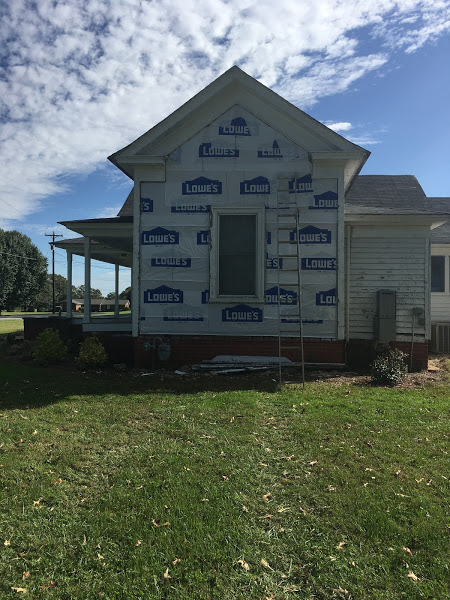
I’m not exactly sure where three-year-olds get their energy. It seems like Thomas is forever hungry and yet never stops long enough to eat. Mostly, he just plunders the cabinets for a good time, which makes me wonder what children did for fun back before they added on the kitchen to our house. It was added on in the early 1900s, so maybe they just scaled the walls of the outhouse for fun. Our house has had a lot of upgrades over the years, with each generation chipping in to make the floor plan more confusing. For our part, it seems like we’ve been re-siding the outside of the house for four years because, well, we have (part of the reasons old houses are so strong is because they’re armored in twelve layers of lead paint).

All I know is any house worthy of a mortgage at current interest rates ought to be well built, meaning it ought to be able to withstand a three-year-old, ideally generations of them. 

Board By Board

In a moment of inspiration, I once grabbed a crowbar and decided on a whim to start a small home improvement project. I decided to start re-siding my house with hardie board and installing insulation in the walls. Now, two and a half years later, I’m finally on the last wall of my house, and I no longer feel inspired. I can firmly say I’m now anti-inspiration. I’ve come to the conclusion that if I need to be inspired to do something, that something probably doesn’t need to be done. 

Don’t get me wrong, I’m sure I saved a ton of money by doing the work myself, but that said I likely also lost several years off my life-expectancy due to lead poisoning. People always talk about how well-built old homes are, but in reality, I think old homes are just well armored. The old wood boards I pried off my house were likely covered in so much lead that I could have pawned them off as metal at the scrap yard. They had at least a dozen layers of paint, dating back to the original paint used way back in 1893. 

On a positive note, in the two and a half years it has taken me to re-side our house, I’ve had a lot of time to think about life priorities and core values while climbing up and down a ladder toting hardie board. Once, after a day of much introspection, self assessment, and ladder climbing, I had a self revelation and decided upon the following maxim as my new personal life slogan, “Never start a project you can’t finish in two hours.” 

However, now that we have a child, I’m considering a revision: “Never start a project you can’t finish in twenty minutes.”

Ode to an Old Stove

Disclaimer: No mice were harmed in the writing of this blog post. One merely napped for an eternity after it chewed a wire in our old stove and decomposed, producing an oversized stench that was surprisingly difficult to trace. First, I checked the usual places for gag-producing odors—the trash can, diaper bin, sink drain, and dishwasher. Nope, not the specific odor molecules in question. Unable to pinpoint the source, I tried to drown it out with a downpour of Febreze. But, three days in, the smell grew worse than the time a possum sequestered itself in the wall. At our wits end, Natalie and I pulled everything out of the kitchen, stove included.

The movement caused the hidden carcass to emit an intense burst of unwholesome particles, at which point Natalie’s nostrils detected the proximate location. I trained my nose on the coordinates and confirmed that the odor originated deep beneath the left back burner.

The stove in question was an old Hotpoint stove, circa the 1950s. Natalie was quite fond it, since it had achieved vintage status, even though the stove was a danger to both mice and men. Before it killed the mouse, it had nearly killed me. A few years ago, I was cooking grits and frying some bacon at the same time: metal spoon stirring grits, metal fork flipping bacon. I can tell you from experience that one does not fly backwards, as if shot out of a cannon, when suddenly jolted by electricity. That is the stuff of cartoons. Instead, after becoming a conduit for electrons, one’s body merely goes limp and sinks to the floor. There, you feel like taking a nap for a while, save for a pounding headache.

Even after the stove electrocuted me, Natalie’s devotion to it held strong and she decided not to replace it. She recommended a much cheaper solution, a wooden spoon. So the moral of this blog post is if you ever want your spouse to discard a sentimental kitchen appliance in favor for something more modern and less life-threatening, place a dead mouse in it. Not long after we discovered the mouse carcass, the Hotpoint took its final plunge into the scrap metal bin at the trash depot. It had cooked its last piece of meat, a rodent.

The High Art of Elevated Dumbery

Some people think you can just do dumb things without any forethought, but learning how to do dumb things responsibly takes years of diligent practice. And some people, realizing how difficult it is to do dumb things responsibly, try to avoid doing dumb things all together. My wife is one of those people. She just let’s me do all the dumb stuff and then reaps the rewards. 

For instance, last week a smoke detector started chirping in the middle of the night and was disturbing her slumber. With a sharp elbow to my ribs, she then disturbed my slumber and said, “Fix it.” 

Our old farmhouse has twelve foot ceilings, and I didn’t feel like going to the barn to retrieve the ladder, so I did what any reasonably trained person in the art of doing dumb things would do. I erected a makeshift tower using chairs and advanced engineering practices (big chairs on bottom; small chairs on top), climbed it like King Kong, and then used a plunger to extend my reach and twist down the smoke detector. Then I went back to bed. The next morning when my wife woke up and saw the chair tower still standing, she was deeply impressed and said, “That was really dumb. I’m surprised you didn’t fall.”

What my wife didn’t realize, however, was that I had been building and climbing chair towers ever since I was a little boy searching for hidden Christmas gifts. Not only did that tower represent years of study in the art of doing dumb things, but it stood as monument to my specialization in elevated dumbery, or the branch of doing dumb things from heights. In college, my friends and I dedicated several Friday nights to studying elevated dumbery. In fact, whoever decided to add brick latticework to the side of the freshman men’s dorm at Wingate University should have just put a three-story rock climbing wall. 

Anyway, after years of careful study, I’m proud to say I just recently composed my magnum opus in elevated dumbery. It takes the form of a traditional limerick, but uses a few variations in meter and rhyme to really emphasize the dumbery. I call it, “Ladder in the Front-End-Loader.” It was inspired by my ongoing attempts to clad our old farmhouse in hardie board. Prepare to be impressed:

Ladder in the Front-End Loader

A man was re-siding his house

to impress and delight his spouse.

He couldn’t reach the gable,

so he lifted and made a ladder stable–

and somehow lived to write this magnum opus.